Guts

We have 22 feet of small intestine. I don’t think we appreciate that enough. 22 FEET. I am more guts than anything else. I am basically guts tucked into a cavity with limbs, connected to a brain. We all are.

Clearly I’ve been reviewing my physiology notes.

But seriously, our small intestine is under appreciated. It’s what really runs the digestive show, not the stomach. The stomach is just the blender that dumps into the intestine, where all the nutrients are actually absorbed.

It’s so strange to think about how little we think about how our bodies work. How much we don’t really know or understand. About our own bodies?! It makes me kinda mad,

So from our guts, it goes into our blood, then to our liver and then out and about (brain, heart, etc).

For some reason (insert lots of sarcasm here), I always pictured mouth-stomach -ass-thighs.

When really it’s mouth (stomach)-guts-blood-heart-brain-body.

From one set of guts to yours, LC.

First Impressions in 2021: Parent Teacher Conference on Zoom

I’ve learned a lot about first impressions, in the year of our plague, 2021.

A) I’m usually Wrong in my assessment

B) Tone is hard to read in text

C) There’s no point in pre-stressing over might-be issues

Historically, I don’t have the best track record with first impressions– that is, what I first notice about other people, my first read on them. (I have no control over what other people’s impressions are of me– I’ve always been afraid to find out, so I pretend it’s not important).

But my first read on someone is almost always wrong.

Okay, that’s not entirely true. But… painfully accurate.

The people I am initially drawn to most are often the most toxic or dangerous (and therefore exciting and interesting). The people I initially overlook tend to be the ones I really appreciate upon knowing better. This is less true with men. My initial read on men is a bit more accurate. I still swing and miss a lot, but my batting average is higher.

This is all to say, I headed into our parent teacher conference CONVINCED that my kid’s teacher was going to be adversarial.

Parenting a kindergartner during the pandemic is really interesting. We also had the privilege of parenting preschoolers during the pandemic, so we’re a real interesting breed of incoming parents.

I have not been into her classroom or allowed past the gate of her campus. All my interactions with her teacher have been over email (See lesson B).

Long story not-so-long, I log onto Zoom bracing myself to be yelled at for having the kid who dances and gets in trouble for singing, and cuts her hair, and is sent to the office, and is basically all your favorite kid characters like Ramona Quimby and Calvin, and Pippi Longstocking, who you love to read about but is exhausting to raise?

And instead, I see a veteran teacher, smiling, talking about how the other kids don’t always know what mine is doing, but she does– she’s dancing the letters as they sing them, she’s exploring acoustics, she’s bouncing to the beat of her own drum. And I see an ally. And I’m so grateful I could cry (and for once am glad I’m not in the classroom but logged in from my kitchen table), so I say thank you and click off to get a glass of water and a snack.

And I think of how sick I’d made myself in anticipation of this meeting. And how silly it was of me to assume the worst out of a public educator. And how proud I am of my girl for being 100% herself. And how lucky I am that her teacher sees and values that too.

From one Laura to Another

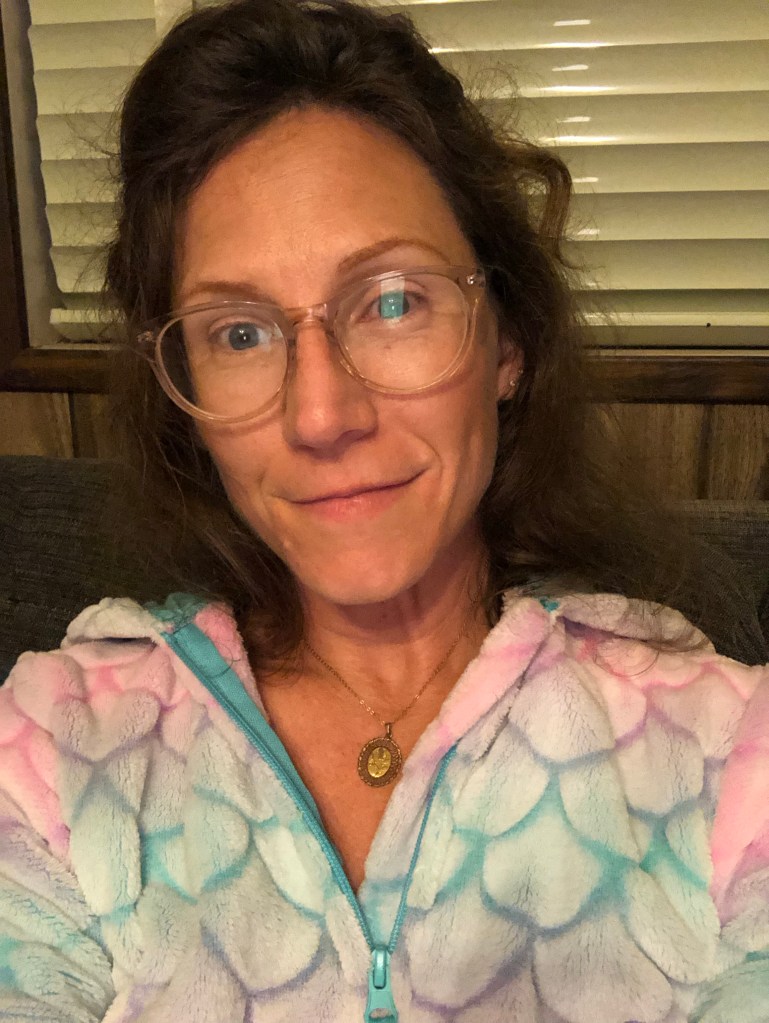
This necklace belonged to my great-great aunt Laura (what the L really stands for).

She was the daughter of German immigrants- mother from Prussia, father from Bavaria, he came to the US at 18. But Henrietta came when she was only 2, and spoke with no accent due to her work (as a young girl) as a live-in nanny. Later she worked in a boarding house where she met this German dude Frank.

They had four girls (my great grandmother, Aunt Laura, and

This necklace belonged to my great-great aunt Laura (what the L really stands for).

She was the daughter of German immigrants- mother from Prussia, father from Bavaria, he came to the US at 18. But Henrietta came when she was only 2, and spoke with no accent due to her work (as a young girl) as a live-in nanny. Later she worked in a boarding house where the Frank roomed and ate.

They had four girls (my great grandmother, Aunt Laura, and two who sounded fun and never married), and one boy.

Laura, whose necklace I’m wearing, had one child, a daughter, who as “just a girl,” was seen as unworthy of an education. Well she went on to get her PhD, become a beloved professor, Distinguished Teacher, and Chair of Management at WisconsinState University

In her time, this was unthinkable.

As another Laura and mother of One Girl, I recognize that I cannot imagine the life that will be available to my child.

And I wish I’d remembered to snap a pic before I got in my pjs.

Eh. It doesn’t have to be perfect.

The Return of Color

Sometimes I forget some of the things in my life. Not in an amnesiac way, more like the dusty memory balls from Inside Out.

A dozen years ago while living in Brooklyn, I woke up to a BLAZING whiteness. At first I thought I’d left the curtains open and overslept, then I realized my eyes were still closed. And one of them HURT.

I’d scratched my cornea before so that was on my radar and I knew there was an optometrist near work so I headed out. But the whiteness was relentless and the pain was loud and the optometrist was closed.

I tried to push through but I could not. Haley, my manager, told me to go to the NYC Eye and Ear Hospital on 14th. I took the L. I don’t know how I managed the subway but I didn’t have a choice.

I was so scared, I couldn’t see, it hurt and I was alone. I was texting with a friend, Heather, and her mom called me and stayed on the phone with me so I wasn’t alone.

A course of antibiotic eye drops alternating with steroids every half hour stopped the ulcer on my cornea from expanding and helped it heal. And slowly my near sightedness returned and I could see. I was lucky that the scar is just outside my field of vision. My eyesight was spared.

I’d let that memory get dusty. The vulnerability and fear. The pain and the loneliness. The unknown and then the whiteness faded and in could see color again.

When I say you are a miracle, I mean it. Our bodies are miraculous. Our capacity to heal is extraordinary. I remember the white and the pain and the delight when color came back. And Shelley, praying with me on my flip phone.

A dozen years ago.

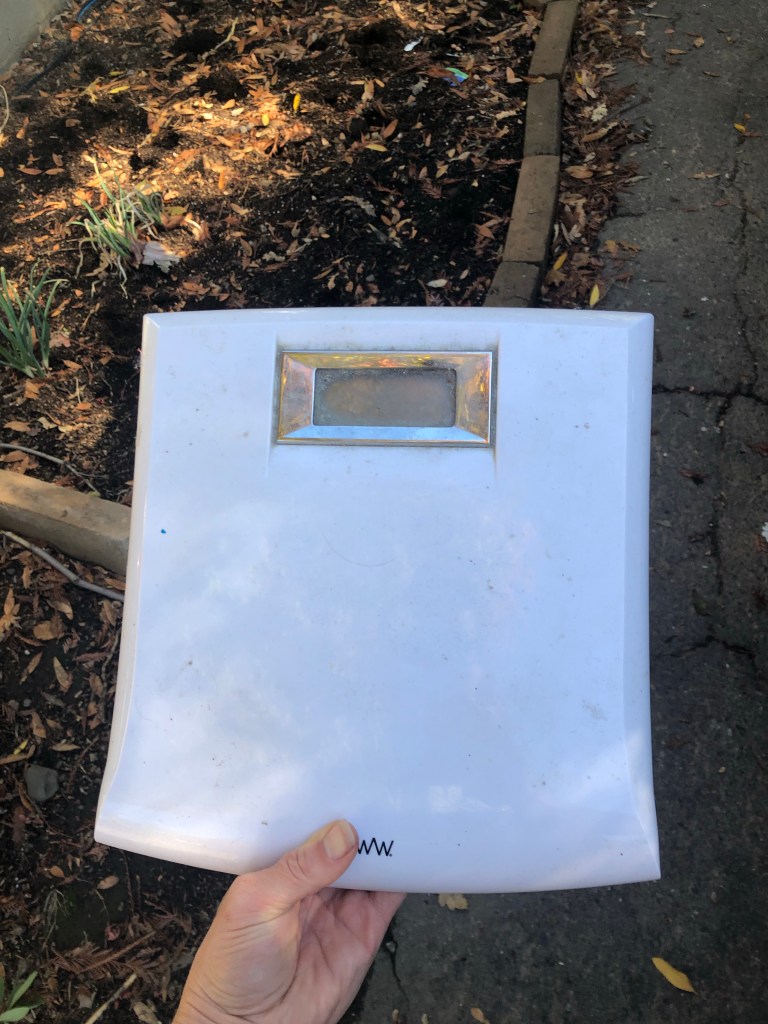
This is not a scale

This is a trap.
This is going in Time Out.

It can come out when I no longer imbue it with the power to determine my mood.

I know who I am.
I know how I feel.

Yet time after time I forfeit that power— I hand it over to a number that tells me only my gravitational mass.

I spoke with my brilliant and wonderful therapist who asked me both: a) what I needed to do for my freedom and b) what I was willing to do today.

I hope that one day I will truly be free from external validation. That I will not only know, but trust myself. That a stupid scale won’t have the power to ruin my day.

In the meantime, I can zap the scale of that power by not stepping onto it.

I wish I could say I chucked it in the bin but I wasn’t ready for that. It would’ve been performative of a recovery I haven’t yet unlocked.

So instead I put it in my husband’s trunk. Progress, not perfection.

Perpetual Healing and Recurring Recovery

This is about my neck. And every thing really. But last night my neck got angry.

Ten years ago, I sustained a life altering injury to my neck and shoulders when two cases of produce fell off the top shelf of the walk-in and got me like a guillotine.

My healing and recovery have been miraculous— long going but I regained more than they thought possible. But every now and then the damage makes itself known. Like right now.

So it’s Salon Pas and the massage drill and my TENS unit and heat and stretching. It’s anti-inflammatories and cancelled appointments and trying to get seen. And it’s amazing how fast the adjustments click in.

I’d almost forgotten about keeping dishes on the counter instead of the cabinets so I can access them.

Picking things up with my left side only. Tilting the milk down instead of lifting the jug. Calculating my route so I don’t have to shift, stop, or turn as often.

Momming is the hardest part. I try to explain the injury but it was before she was born and it is invisible. No band aid or blood, nothing to indicate to a kindergartner than her usually robust mother is out of service.

But we do it. We manage. Then she playfully climbs on me and I shriek in pain and fear. And she cries and I cry and I apologize and try to explain.

The progress is still there even if today it feels erased. Because I could sleep last night and I remember when I couldn’t. I remember when 40 minutes in one position was all I could take.

I remember the haze of painkillers and how they didn’t kill the pain but just made me care less about it.

I remember the fear that nothing would change and my anger and despair.

I remember when recovery was my full time job. Therapies and adjustments and trainings and dietary changes. The itchiness and awfulness of getting off those pills. The ease with which the doctors offered them to me again and again and again. My determination to never have to get off them again. And I remember the day I left acupuncture and could finally turn my head. I remember my resilience and my strength.

And I get out my foam roller and get back into my healing. And though it sounds cliche, I am grateful for my capacity to heal and to remember.

I remember where I’ve been, I remember that I won’t stay here forever. That it may feel like defeat but it’s part of my progress.

I try to release my anger at myself and the medical team. I know it doesn’t serve me to play the injustices on repeat. I try to release my self-judgment and self-loathing for failing to advocate for myself. For not demanding an ER visit and imaging. For waiting. For “being good” and “not causing trouble” and possibly prolonging the pain by refusing to admit it. By internalizing it and letting the men brush me off.

I remind myself that those lessons came at a dear cost but I cannot let the cost erase the lesson, for THAT would truly be a shame. I remind myself that I have learned how to advocate for treatment and I share that hard-earned knowledge. I know how to take care of myself if I remember TO take care. And when I don’t remember? My body reminds me.

And my child is witnessing that a disability can live in any body. That strength and damage can coexist. That one day I may run three miles and the next day I have to tilt the milk. And both days I am worthy and complete.

One day, if I’m lucky, I will be a very old woman with aches and gnarled joints and dry feet and cold hands.

So today I stretch and moisturize and cozy up and take care. I hope you can take care too.

Ego

The WORST

I was listening to a woman I admire and she said something that landed so hard I have to share it. She said that she can’t say she had “low self-esteem,” because she had “no self-esteem.” And that part I’d heard before and nodded along with, but then she went on to remind me that thinking so poorly of ourselves is another form of self-centeredness. And that knocked me on my ass.

Because it is selfish, and self-centered, to think that you are THE WORST. And when you’re a recovering perfectionist, your knee jerk reaction to anything less than perfect is to declare it the WORST.

But I’m not the worst, I’m not even like medium worst, I’m accidentally terrible from time to time, but I’m learning to accept that as part of the human condition. And just aim for okay.

When I can reframe my self-loathing as self indulgence and remind myself that those feelings aren’t facts, I feel like I can skip the train. I can let it go by without climbing onboard.

So if you start to feel like you’re the worst… remember you’re not. I’m not going to say “we’re great and you’re perfect,” because… maybe we’re not but we don’t have to be. And if rah-rah- sis-boom-bah recovery isn’t for you, I hear that.

Because somedays I don’t want to hear that I’m a ray of sunshine and a child of the multiverse, because sometimes I’m a storm cloud throwing a tantrum. But here’s a thing that helps me when my monster starts to tell me I’m the worst.

I used to try to tell my monster to shut up. For years I listened to her and handed over control, and then I locked her in a cage and told her to shut up. But she’s been talking to me for years, whispering, screaming, and now I’m trying something new.

Instead of locking her up inside me, I go down and let her out. We sit and talk.

“You’re the WORST.” “I’m the– oh hey. I’m not the WORST, who’s the WORST?”

And we think of someone who might qualify. Someone who kicks dogs and splashes pedestrians and doesn’t tip. And I come up with things and she comes up with things and it’s fun to start to think about the worst person ever and right before it gets way too dark (or sometimes right after), we dissolve into giggles and I invite her up.

She isn’t ready to leave, but we can settle back in having determined that we are not, in fact, THE WORST.

Maybe we’re okay. And isn’t okay the goal?

I always thought I wanted to be superhuman. To do all the things. But now I’m going to try just being human. In all the things.

Grr-attitude, Gratitude and Grief

I bristle at a lot of advice I’ve received and I cringe sometimes, worrying that I am perpetuating toxic ideology. I won’t dare to assume what another human is going through, and I am no model on how to handle life beautifully and gracefully.

In fact, I often feel like I have more Grrr-attitude than gratitude.

The mere mention of “gratitude” can cause internal (and external) eye-rolls on my part. It evokes images of placidity, complicity, and a dereliction of duty. Like, instead of going after the things that need to be changed, women are told to “be grateful” for what we have.

And like a grumbling Anya in “Anastasia,” I get real snarky real quick.

But I am no longer a sullen teenager raging against the inequities of the world. I am a woman who faces them. I am a mother working to change the things that I can. And what I’m learning is that gratitude is less about counting your blessings and ignoring the curses, and more about seeing both at once. It’s about maintaining those blessings in the presence of curses.

Because the blessings abound (okay I just threw up in my mouth a little), but they really do. I have a roof and heat and a safe bed. I have clean water and clean air. It will rain soon and that always feels nice. I have power and internet and have been vaccinated against horrible diseases that killed my ancestors and plagued my father-in-law.

All of that is true, and none of it is less true in the face of all the other horrible truths that surround me.

Navigating grief is a heck of a thing. I am feeling every feeling I’ve ever encountered. Rage, despair, painful joy, brutal hope, and bright red anger when that hope proves poorly founded. And while I struggle to accept gratitude within my grief, because it reeks of Disney and Pollyanna, I am (gulp) grateful for my grief.

WHY? HOW?

Because it means I have held on to my humanity though all of this. I grieve because I love, and while it makes me vulnerable to pain, I would not give up my capacity for love for anything in the world– not even the protection of isolation.

Vulnerability is hard, but it beats the socks off of the numbness I’ve sought and surrounded myself with for decades.

Gratitude does not mean I’m throwing a pink filter on everything and saying “this is great” or even “everything happens for a reason” (EWWW!!!!). Nothing is more insulting than to claim someone’s pain and suffering is all part of some grand design. My anger rears up at the arrogance and callousness of statements like that.

No wonder I resisted “gratitude” for so long. I had a corrupted concept of what it meant. Gratitude, for me, is not “choosing to see the good instead of the bad”, (also known as selective acceptance) but seeing it all. Putting AND in place of OR. That things are terrible and beautiful. That people are loving and cruel. That I am grateful and overwhelmed with grief.

That opposing truths do not cancel each other out, but add depth to the human experience. Their duality is not a contradiction.

We can be grateful for 4 weeks paid leave and still know that it is not enough. I can be grateful for my beautiful family and still mourn the losses we’ve sustained. I do not have to pick one side, I contain multitudes.

My grief is as deep and overwhelming as my love.